

If Christopher Hitchens were to walk into the present moment—tie slightly loosened, glass in hand, eyebrow already arched in preemptive skepticism—he would not be surprised. He would, however, be disappointed. Not because the world has changed too much, but because it has changed so little.

The strange phrase now circulating online—“Christopher Hitchens resurrected”—is less about literal revival and more about intellectual necessity. In an age saturated with misinformation, ideological tribalism, and a renewed appetite for comforting falsehoods, the voice of Hitchens feels less like a relic and more like an urgent requirement. His ideas are not merely returning; they are detonating across digital culture with renewed force.
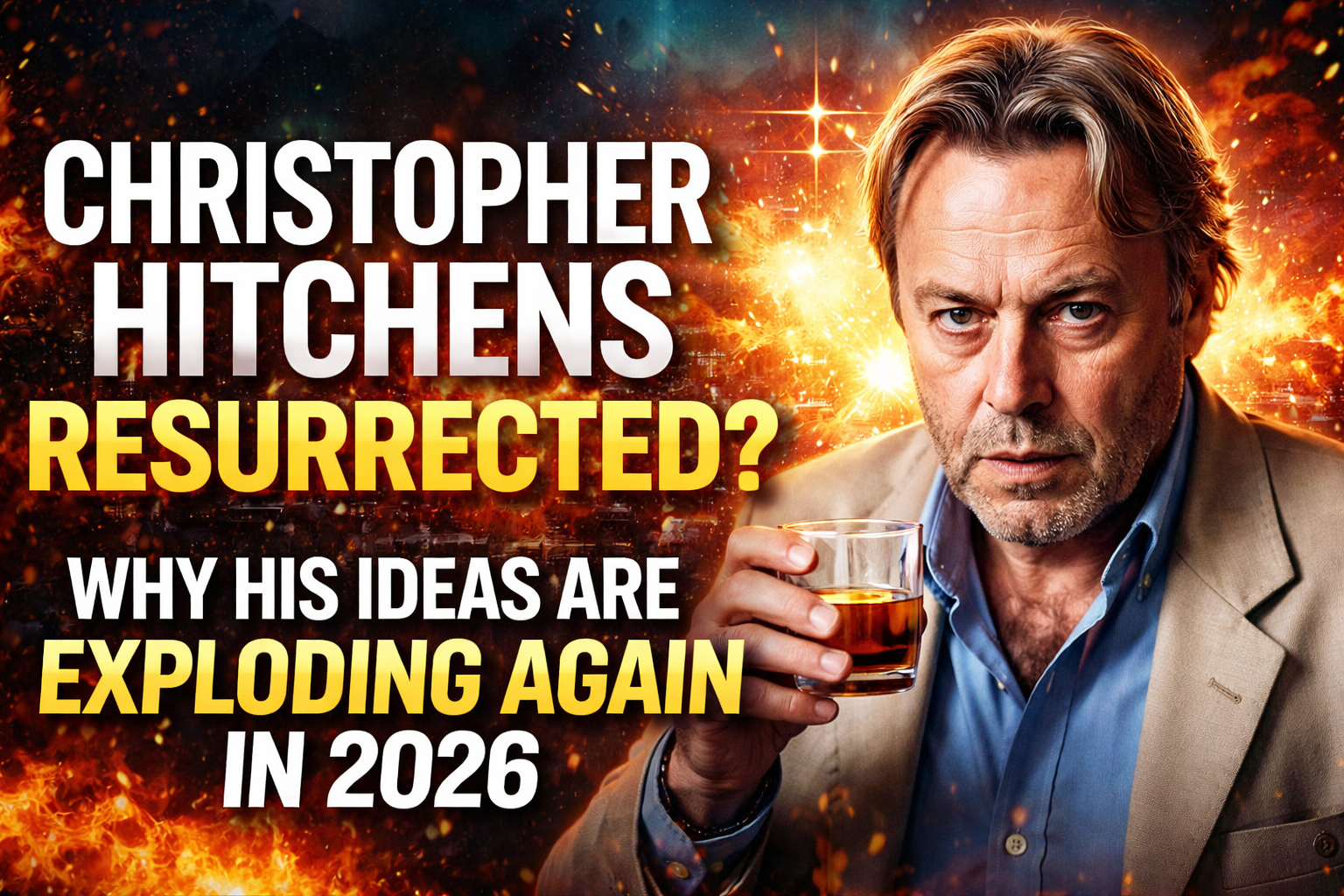
Hitchens, who died in two thousand eleven, built his reputation not on politeness but on precision. He rejected the notion that deeply held beliefs deserved respect simply for being deeply held. “What can be asserted without evidence can be dismissed without evidence,” he famously argued—a line that has found new life in the algorithmic chaos of twenty twenty-six. In a world where claims travel faster than scrutiny, his insistence on evidence feels almost revolutionary.
So why now? Why is Christopher Hitchens trending again, his debates resurfacing, his quotes circulating like intellectual contraband?
The answer lies partly in fatigue. People are tired—tired of being manipulated, tired of being told that truth is subjective, tired of watching public discourse dissolve into spectacle. Hitchens represents a kind of intellectual clarity that feels almost extinct. He did not hedge, he did not soften, and he certainly did not pretend that all viewpoints were equally valid. In today’s climate, that level of candor cuts through noise like a blade.
Another reason is the cyclical return of the very forces he spent his life opposing. Religious extremism, authoritarian politics, and the erosion of free expression are no longer distant concerns; they are immediate realities. Hitchens warned, repeatedly, that unchallenged dogma—whether religious or political—inevitably seeks power. And when it finds it, it rarely relinquishes it peacefully.
In twenty twenty-six, that warning reads less like opinion and more like prophecy.
Consider the digital landscape. Social media has become both a platform and a battlefield, where ideas compete not on merit but on virality. In such an environment, nuance is often sacrificed, and outrage becomes currency. Hitchens, who relished debate and demanded intellectual accountability, would have found this both fascinating and infuriating. He believed in argument—not as performance, but as a means of arriving at truth. The modern tendency to avoid offense at all costs would, to him, appear as a kind of moral cowardice.
Yet it is precisely this avoidance that has created space for his resurgence.
Search trends reveal a growing interest in “Christopher Hitchens debate,” “Christopher Hitchens quotes,” and even speculative phrases like “Christopher Hitchens on modern politics.” These are not merely nostalgic queries; they are signals of a deeper hunger. People are not just revisiting Hitchens—they are searching for tools, for frameworks, for a way to think more clearly in a world that increasingly rewards confusion.
There is also the matter of courage. Hitchens was, above all, unafraid. He criticized religion in front of religious audiences, challenged political orthodoxy on both the left and the right, and refused to align himself with any tribe that demanded intellectual compromise. In an era where dissent is often met with digital excommunication, that kind of independence feels radical.
It is tempting to romanticize his return, to imagine that if Hitchens were alive today, he would single-handedly restore sanity to public discourse. That, of course, is a fantasy—and one he would likely dismantle himself. Hitchens did not believe in saviors, intellectual or otherwise. He believed in individuals willing to think, question, and speak without fear.
The real question, then, is not whether Christopher Hitchens has been resurrected, but whether we are finally ready to listen.
His ideas are exploding again in twenty twenty-six not because they are new, but because they were never properly absorbed. They remain as sharp, as inconvenient, and as necessary as ever. In a time when truth is negotiable and conviction is often performative, Hitchens offers something rare: a standard.
A standard that demands evidence over assertion.
A standard that values argument over agreement.
A standard that refuses to grant immunity to bad ideas, no matter how popular they may be.
And perhaps that is why his voice echoes so loudly now. Not because it has returned, but because it never truly left.