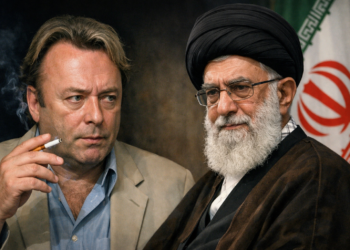


Welcome to “The Unquiet Mind: A Hitchensian Deconstruction,” an unflinching exploration into the intellectual universe of Christopher Hitchens. To define the Hitchensian voice is to speak of a rare, potent alchemy: the rapier wit of a seasoned polemicist, the vast erudition of a lifelong autodidact, and the unflinching criticism of a man utterly allergic to cant and hypocrisy. He was a master of the essay, a formidable debater, and a tireless advocate for secularism and reason. His intellectual lineage traces back through the clear-eyed skepticism of George Orwell, whom he admired profoundly, to the Enlightenment thinkers, culminating in his pivotal role within the New Atheism movement. For Hitchens, argument was not a mere intellectual exercise but a vital, often confrontational path to uncovering truth. He understood that provocation, when wielded with precision and purpose, could shatter complacency and force an examination of cherished, yet often baseless, beliefs. This exploration aims to dissect his critiques of religion, politics, and to envision his probable, devastating indictment of Donald Trump, all delivered with the distinctive, deeply sarcastic and incisive style that defined “Hitch.”

The Religious Question: ‘God is Not Great’ Revisited
In the grand theater of human folly and intellectual cowardice, few performances drew Hitchens’s withering gaze quite like the spectacle of organized religion. His seminal work, ‘God is Not Great: How Religion Poisons Everything,’ wasn’t merely a critique; it was a meticulously constructed demolition, delivered with the panache of a master builder dismantling a fraudulent edifice. He saw faith not as a benign opiate, but as a pernicious virus, infecting minds, distorting history, and stifling the intellectual maturation of our species. The audacity of belief in the face of demonstrable absurdity, the moral contortions required to rationalize ancient barbarities, the sheer effrontery of claiming divine sanction for human prejudice – these were the wellsprings of his righteous indignation. He refused to grant religion its customary polite deference, preferring instead to expose its naked pretensions and the often-squalid realities it both spawned and sustained. For Hitchens, God was not merely absent; the very idea of such a being was a moral outrage, an intellectual surrender, and an historical catastrophe. His arguments against the divine were never simply academic; they were impassioned pleas for humanity to finally grow up, cast off its supernatural shackles, and embrace the daunting, yet infinitely more rewarding, challenges of a rational existence. The ongoing appeal of religion, for Hitchens, spoke less to humanity’s yearning for transcendence and more to its persistent susceptibility to comforting lies, its inherent fear of the unknown, and its regrettable fondness for abdicating personal responsibility to an imaginary celestial overlord. It was a condition to be diagnosed, dissected, and ultimately, cured, not coddled.
The Case Against Heaven: Moral, Historical, and Philosophical Objections to Faith.
Hitchens found the concept of heaven, and indeed any divine promise of afterlife, to be not merely improbable but morally repulsive. He argued that it rendered this singular, precious life insignificant, diverting human attention and effort from tangible earthly improvements towards the ethereal hope of an unproven paradise. The promise of eternal bliss, bought by credulity and blind obedience, struck him as a particularly nasty bait-and-switch, a cosmic pyramid scheme where the faithful sacrificed critical thinking and earthly pleasures for an utterly unsubstantiated reward. Furthermore, the historical record, he painstakingly demonstrated, was awash with atrocities committed in the name of securing a place in said heaven, or preventing others from reaching their own version of it. Philosophically, the entire construct was a dodge, an intellectual retreat from the profound questions of existence and meaning into the facile answers of dogma. Hitchens posited that true morality stemmed from human empathy and reason, not from the fear of divine punishment or the hope of supernatural reward.
Critique of Organized Religion: Power, Hypocrisy, and the ‘Infantilization of Humanity’.
Organized religion, for Hitchens, was a naked power grab, a mechanism for control and the perpetuation of ignorance. He excoriated its inherent hypocrisy, observing how self-proclaimed holy men, shielded by sanctity, often reveled in worldly power, wealth, and privilege while preaching austerity to their flocks. The ‘infantilization of humanity’ was a core tenet of his critique: religion encouraged a perpetual state of childhood, where individuals deferred to clerical authority, accepted simplistic explanations, and were discouraged from independent thought and moral autonomy. It provided pre-packaged answers to profound questions, thereby stifling curiosity and intellectual growth, keeping humanity in a state of arrested development, forever supplicating to an imagined paternal figure.
Religion and Totalitarianism: From Theocracy to Fanaticism.
Hitchens drew stark parallels between theocratic ambition and totalitarian regimes, arguing that both demanded absolute ideological fealty, crushed dissent, and sought to impose a single, unchallengeable truth upon all aspects of human life. From the crushing strictures of various Islamic states to the historical inquisitions of Christianity, he saw a common authoritarian impulse. Religious dogma, he contended, provided the perfect psychological blueprint for totalitarianism, priming individuals for unquestioning obedience and validating the persecution of “infidels” or “heretics.” Fanaticism, whether religiously or politically motivated, invariably led to the same grim outcomes: censorship, oppression, and violence in the name of an ultimate, unimpeachable authority.
The Illusion of Comfort: Why Religion Offers False Solace.
While acknowledging the human need for comfort in the face of suffering and mortality, Hitchens steadfastly refused to concede that religion offered any *true* solace. Instead, he argued it offered an illusion, a hollow comfort purchased at the high price of intellectual integrity and confrontation with reality. The idea of a benevolent God overseeing a world rife with unmerited suffering struck him as particularly galling, making the notion of divine comfort a cruel joke. He suggested that confronting the finite nature of existence, the randomness of the universe, and the absence of supernatural intervention, though initially discomforting, ultimately led to a more profound, more authentic appreciation of life and a greater determination to make meaning within its earthly bounds. True solace, for Hitchens, came from courage, reason, and human solidarity, not from supernatural fairy tales.
Politics, Power, and the Perils of Ideology
Hitchens’s political journey was never a placid cruise but a turbulent odyssey across ideological oceans, marked by intellectual courage and a profound disdain for tribal loyalties. He began as a committed socialist, a Trotskyist who dreamt of revolutionary transformation, yet his intellectual honesty compelled him to challenge the very orthodoxies he once espoused. He became, as he described himself, a “contrarian,” an “apostate,” a man forever wary of any cause that demanded unthinking adherence. The greatest threat, he observed, was not necessarily the malice of individuals, but the sheer, unthinking momentum of collective delusion, whether cloaked in the rhetoric of the left or the sanctimony of the right. He saw politicians, regardless of their professed creed, as susceptible to the same temptations: power, self-deception, and the insidious habit of trading principle for expediency. His interventionism, particularly his controversial support for the Iraq War, stemmed not from some newfound neoconservative allegiance, but from a consistent, if sometimes misguided, belief in the necessity of confronting genuinely totalitarian evil, even if it meant aligning with unlikely bedfellows. For Hitchens, a principled foreign policy was one that identified and opposed tyranny wherever it manifested, refusing to allow cultural relativism or anti-American sentiment to obscure the fundamental differences between open and closed societies. He was acutely aware of the ‘tyranny of the unthinking,’ the frightening ease with which mass movements could hypnotize populations, demanding ideological purity and punishing intellectual deviation. His commitment was always, ultimately, to reason and human liberty, even when it led him down paths that alienated former comrades and baffled new admirers. He was a political meteor, burning brightly, scorching dogmas, and leaving behind a trail of inconvenient truths.
Against the Sacred Cows: Unmasking Pious Frauds Across the Spectrum.
No figure, no movement, no ideology was immune to Hitchens’s critical scalpel. He delighted in unmasking the “pious frauds,” whether they were Mother Teresa (whom he famously denounced as a “fanatical fundamentalist, a fraud, a thief, and an accomplice of the most corrupt regimes”), the Clintons, or the various intellectual darlings of the left or right who dared to trade in sentimental platitudes or convenient lies. He reserved particular contempt for those who claimed moral superiority while practicing intellectual dishonesty or personal corruption. For Hitchens, the “sacred cows” of any political persuasion were merely idols constructed by laziness and fear, and his greatest pleasure was in toppling them with a well-aimed rhetorical blow, exposing the hypocrisy beneath the veneer of sanctity.
Left, Right, and the Perpetual Apostate: Hitchens’ Evolving Political Stance.
Hitchens’s political evolution was a testament to his intellectual independence and his refusal to be confined by labels. Starting as a staunch socialist and Trotskyist, he gradually became disillusioned with the left’s anti-Americanism, its moral relativism regarding totalitarian regimes, and its increasingly sentimental view of victimhood. His support for intervention in the Balkans and later, in Iraq, marked a definitive break, leading him to be labeled a “neoconservative” by some, a label he vehemently rejected. He saw himself as a “perpetual apostate,” always willing to abandon a belief system once it ceased to align with his core commitment to liberty, reason, and the fight against totalitarianism. His position was less about left or right, and more about consistently identifying and opposing tyranny.
Interventionism and Internationalism: The Case for a Principled Foreign Policy.
Hitchens was a passionate internationalist, believing that the principles of human rights and self-determination were universal and transcended national borders. This conviction underpinned his controversial support for military intervention in places like Bosnia, Kosovo, and Iraq. He argued for a principled foreign policy that was not afraid to confront egregious human rights abuses and genuine threats to global stability, even if it meant challenging existing diplomatic norms or incurring domestic unpopularity. For him, the failure to act against tyrannical regimes, particularly those committing genocide or sponsoring terrorism, was a greater moral failing than the potential risks of intervention. His was a muscular internationalism, founded on the belief that evil must be named and confronted, not merely contained or appeased.
The Tyranny of the Unthinking: Mass Movements and Intellectual Complacency.
Few things perturbed Hitchens more than the “tyranny of the unthinking,” the insidious way mass movements could override individual reason and critical judgment. He saw this not just in the overt oppression of totalitarian states but in the more subtle forms of intellectual complacency and conformism that could infect democratic societies. The pressure to conform, to adopt fashionable opinions, to refrain from offending sacred sentiments – these were all manifestations of a society abandoning its intellectual faculties. He warned against the dangers of groupthink, sentimentality, and the preference for comforting lies over uncomfortable truths, seeing them as direct threats to genuine liberty and enlightenment. His life’s work was a constant battle against this collective intellectual slumber.
A Hitchensian Indictment of Donald Trump
One can only imagine the incandescent fury, the surgical precision of contempt, and the sheer rhetorical firepower Christopher Hitchens would have unleashed upon the phenomenon of Donald J. Trump. Though Hitchens departed this earthly stage before Trump’s rise, his established intellectual framework provides ample ammunition for a posthumous, devastating indictment. He would have seen Trump not merely as a vulgar buffoon, but as a walking, talking symptom of cultural decay, a grotesque manifestation of everything Hitchens despised: anti-intellectualism, populism, demagoguery, and an utter disregard for truth and reason. The very concept of a reality television star ascending to the highest office in the land, celebrated for his ignorance and vulgarity, would have been, for Hitchens, not merely alarming but an existential insult to the Enlightenment values he championed. He would have dissected Trump’s rhetoric with the cold, unsparing gaze of a forensic pathologist, revealing the underlying emptiness, the calculated deceptions, and the insidious appeal to the lowest common denominator. Trump’s cult of personality, his relentless self-aggrandizement, and his casual contempt for democratic norms would have triggered every alarm in Hitchens’s intellectual arsenal, echoing the demagogues and strongmen he had spent his life denouncing. The celebrated anti-intellectualism, the glorification of ignorance as a virtue, would have been anathema to a man who lived and breathed erudition. For Hitchens, Trump would have represented America’s self-inflicted wound, a moment of national reckoning that revealed a deep-seated vulnerability to charlatanism and a troubling willingness to abandon the very principles that underpin a free society. The performance, for Hitchens, would not have been amusing; it would have been a tragicomic testament to the fragility of reason in the face of mass delusion.
The Grotesque Spectacle: Trump as a Symptom of Cultural Decay.
Hitchens would have viewed Trump as the ultimate “grotesque spectacle,” not an anomaly but a dire symptom of a deeper cultural malady. For a society to elevate such a figure – a man devoid of discernible intellectual curiosity, moral compass, or even basic decorum – spoke volumes about its precipitous decline. He would have analyzed how a culture steeped in reality television, instant gratification, and a growing distrust of expertise could produce such a figure, seeing Trump as the logical, albeit horrifying, culmination of trends he had long warned against: the triumph of superficiality over substance, and the erosion of standards in public life.
Populism, Demagoguery, and the Cult of Personality: Echoes of Past Authoritarians.
Hitchens possessed an acute historical sensibility, and he would have immediately recognized Trump’s populism and demagoguery as dangerous echoes of past authoritarians. The direct appeal to the “people” against perceived elites, the cultivation of a cult of personality, the demonization of opponents, and the contempt for institutional checks and balances – these were all hallmarks of figures Hitchens had studied and abhorred. He would have argued that Trump’s seemingly crude tactics were, in fact, classic demagogic maneuvers, designed to bypass rational discourse and appeal directly to raw emotion, fear, and resentment, creating a loyal, uncritical base.
Ignorance as a Virtue: The Celebration of Anti-Intellectualism.
Perhaps nothing would have enraged Hitchens more than Trump’s celebration of ignorance as a virtue. For a man who revered learning, discourse, and the pursuit of knowledge, the spectacle of a leader who openly disdained experts, facts, and nuanced understanding would have been utterly anathema. Hitchens would have seen this as a direct assault on the very foundations of enlightened society, a deliberate attempt to debase public discourse and replace informed debate with slogans and soundbites. The embrace of anti-intellectualism, he would argue, was not merely a stylistic choice but a dangerous ideological stance that undermined the capacity for self-governance.
The Language of Deception: A Rhetorical Analysis of Trump’s Utterances.
A master of rhetoric himself, Hitchens would have conducted a devastating rhetorical analysis of Trump’s utterances. He would have dissected the repetitive phrases, the vague promises, the self-contradictions, the bullying, and the incessant gaslighting as a calculated “language of deception.” He would have demonstrated how Trump employed a form of verbal nihilism, rendering language meaningless by divorcing it from truth and logic, thereby creating a reality entirely subservient to his immediate desires. For Hitchens, this casual disdain for verifiable fact and the instrumentalization of language for pure power would have been a profound moral and intellectual crime.
America’s Self-Inflicted Wound: What Trump Reveals About the Nation.
Ultimately, Hitchens would have framed Trump as “America’s self-inflicted wound,” a painful revelation about the nation’s vulnerabilities. Trump’s success would have exposed fault lines of resentment, fear, and intellectual laziness within American society, indicating a troubling susceptibility to manipulation. It would have served as a stark warning about the fragility of democratic institutions and the constant vigilance required to uphold principles of reason, civility, and constitutional governance. For Hitchens, Trump would have forced America to confront uncomfortable truths about its own cultural and intellectual health, a bitter pill indeed for a nation he often admired but never uncritically.
The Weapon of Words: Hitchens’ Rhetorical Arsenal
Christopher Hitchens wielded language with the precision of a surgeon and the force of a battering ram. His rhetorical arsenal was legendary, an awe-inspiring collection of literary allusions, historical parallels, cutting sarcasm, and devastating wit, all deployed with meticulous intent. He understood that words were not mere conveyors of information but instruments of persuasion, provocation, and, when necessary, annihilation of specious arguments. His speeches and essays were masterclasses in composition, each sentence crafted to build an undeniable, often discomforting, logical progression. He disdained vague platitudes and intellectual cowardice, preferring instead the stark, unvarnished truth, no matter how unpopular. For Hitchens, a well-placed epigram or a perfectly executed historical comparison could expose a fallacy with more power than a thousand dry statistics. He was a gladiator of the intellect, entering every debate with the conviction that the stakes were nothing less than reason itself, and he fought with every weapon at his disposal, leaving opponents not merely defeated, but often intellectually dismembered.
Sarcasm and Satire: The Precision Instrument of Disdain.
Sarcasm and satire were not mere flourishes for Hitchens; they were precision instruments of disdain, used to expose absurdity and deflate pretension. He understood that ridicule, when judiciously applied, could be a more effective weapon against intellectual dishonesty than direct refutation. By mimicking and exaggerating the flawed logic of his opponents, or by dryly stating the obvious implications of their absurd beliefs, he could render their arguments ludicrous without ever losing his own intellectual footing. His sarcasm was rarely crude; it was refined, often subtle, and always aimed at exposing the underlying foolishness or hypocrisy, leaving the target squirming under the weight of their own exposed absurdity.
The Art of the Ad Hominem (When Justified): Exposing the Man Behind the Mask.
While generally considered a fallacy, Hitchens masterfully demonstrated the “art of the ad hominem” when he believed it was not only justified but necessary. For him, attacking the person was legitimate when that person’s character, motives, or demonstrable dishonesty were integral to the argument they were advancing, or when they claimed a moral authority they clearly lacked. He delighted in exposing the man behind the mask, particularly when dealing with religious leaders or political figures who traded in sanctimony while engaging in venal behavior. He argued that if a person’s character was demonstrably corrupt, their claims of moral or intellectual purity were inherently undermined, and to point this out was not a fallacy but an act of intellectual honesty.
Erudition as Ammunition: Historical Parallels and Literary Allusions.
Hitchens’s vast erudition was not for show; it was his primary ammunition. His command of history, literature, philosophy, and current affairs allowed him to draw insightful parallels and make compelling allusions that enriched his arguments and contextualized contemporary issues within a broader human narrative. He could effortlessly reference Gibbon, Orwell, Marx, or any number of historical figures and intellectual movements, using their insights to illuminate modern follies or reinforce timeless truths. This encyclopedic knowledge gave his arguments depth, resonance, and an intellectual gravitas that few could match, turning every debate into a dazzling display of intellectual firepower.
Debate as Performance: The Intellectual Duelist.
For Hitchens, debate was not just an exchange of ideas; it was a high-stakes performance, an intellectual duel where clarity, wit, and logical rigor were paramount. He was a master of the stage, his booming voice, articulate delivery, and often theatrical gestures captivating audiences. He understood the rhythm of argument, knowing when to deploy a cutting one-liner, when to build a slow, methodical case, and when to deliver the crushing blow. He respected a worthy opponent but showed no quarter to those he considered intellectually lazy or dishonest. His debates were showcases of his formidable intellect, combining rigorous argumentation with an undeniable charisma, making him one of the most compelling public intellectuals of his generation.
Legacy: The Enduring Provocateur
The physical presence of Christopher Hitchens may have departed, but his legacy as the enduring provocateur, the indispensable contrarian, resonates ever more powerfully in an increasingly fragmented and polarized world. He championed the imperative to offend, arguing that truth often requires discomfort, that cherished delusions must be shattered, and that polite silence in the face of injustice or irrationality is a form of complicity. He foresaw, and indeed lamented, the decline of public discourse, a slow erosion of critical thinking, and the ascendance of sentimentality over substance. A world without Hitchens feels profoundly poorer, lacking that unique voice unafraid to call out the emperor’s nakedness, to challenge the pieties of all sides, and to demand rigorous intellectual honesty. His unfinished arguments, particularly concerning the fragility of free speech, the perils of religious fundamentalism, and the challenges to liberal democracy, remain acutely relevant in our post-truth era. He left behind not a rigid doctrine, but a model for intellectual integrity: the courage of conviction, the relentless pursuit of truth through reason, and the unyielding commitment to articulate those truths, no matter the cost. His ghost continues to haunt the corridors of conventional wisdom, a perpetual reminder that the unexamined life is not worth living, and that the unquiet mind is often the most vital.
The Imperative to Offend: Why Truth Requires Discomfort.
Hitchens believed strongly in the “imperative to offend.” He argued that genuine truth-seeking often necessitated challenging deeply held beliefs and confronting uncomfortable realities, which invariably caused offense to those wedded to their illusions. For him, the desire to avoid causing offense was a form of intellectual cowardice that prioritized social harmony over intellectual honesty. He saw it as his duty to articulate inconvenient truths, to puncture sentimental myths, and to provoke thought, even if it meant alienating large segments of the population. He understood that progress often begins with discomfort, and that the path to enlightenment is rarely paved with pleasantries.
The Decline of Public Discourse: A World Without Hitchens.
In a world increasingly characterized by echo chambers, performative outrage, and the relentless tribalism of social media, the absence of Hitchens’s voice is keenly felt. He was a champion of robust, if sometimes vitriolic, public discourse, believing that the clash of ideas, however fierce, was essential for intellectual vitality. He would have decried the decline of nuanced debate, the retreat from evidence-based argumentation, and the growing intolerance for dissenting opinions. His absence leaves a void in the intellectual landscape, a missing bulwark against the forces of anti-intellectualism and rhetorical sloppiness that now seem to dominate public conversation.
His Unfinished Arguments: Relevance in a Post-Truth Era.
Hitchens’s arguments, particularly those concerning the dangers of religious fundamentalism, the fragility of free speech, and the enduring threats to liberal secularism, remain profoundly relevant in our “post-truth” era. He warned against the erosion of objective facts, the weaponization of emotion, and the blurring of lines between opinion and evidence. His skepticism towards authority, his unwavering defense of reason, and his insistence on clear, precise language are more crucial than ever as societies grapple with misinformation and the deliberate obfuscation of reality. His unfinished arguments serve as a powerful toolkit for navigating the intellectual challenges of the 21st century.
The Courage of Conviction: A Model for Intellectual Integrity.
Above all, Hitchens offered a model for intellectual integrity and the courage of conviction. He was a man who lived by his principles, even when those principles led him to unpopular positions or alienated former allies. He never shied away from defending what he believed to be true, regardless of personal cost or social censure. His willingness to change his mind in the face of new evidence, while never abandoning his core commitment to reason and liberty, serves as an inspiring example. His legacy is not merely a collection of arguments, but an enduring testament to the vital importance of independent thought, rigorous inquiry, and the unwavering pursuit of truth in a world too often content with comforting illusions.