


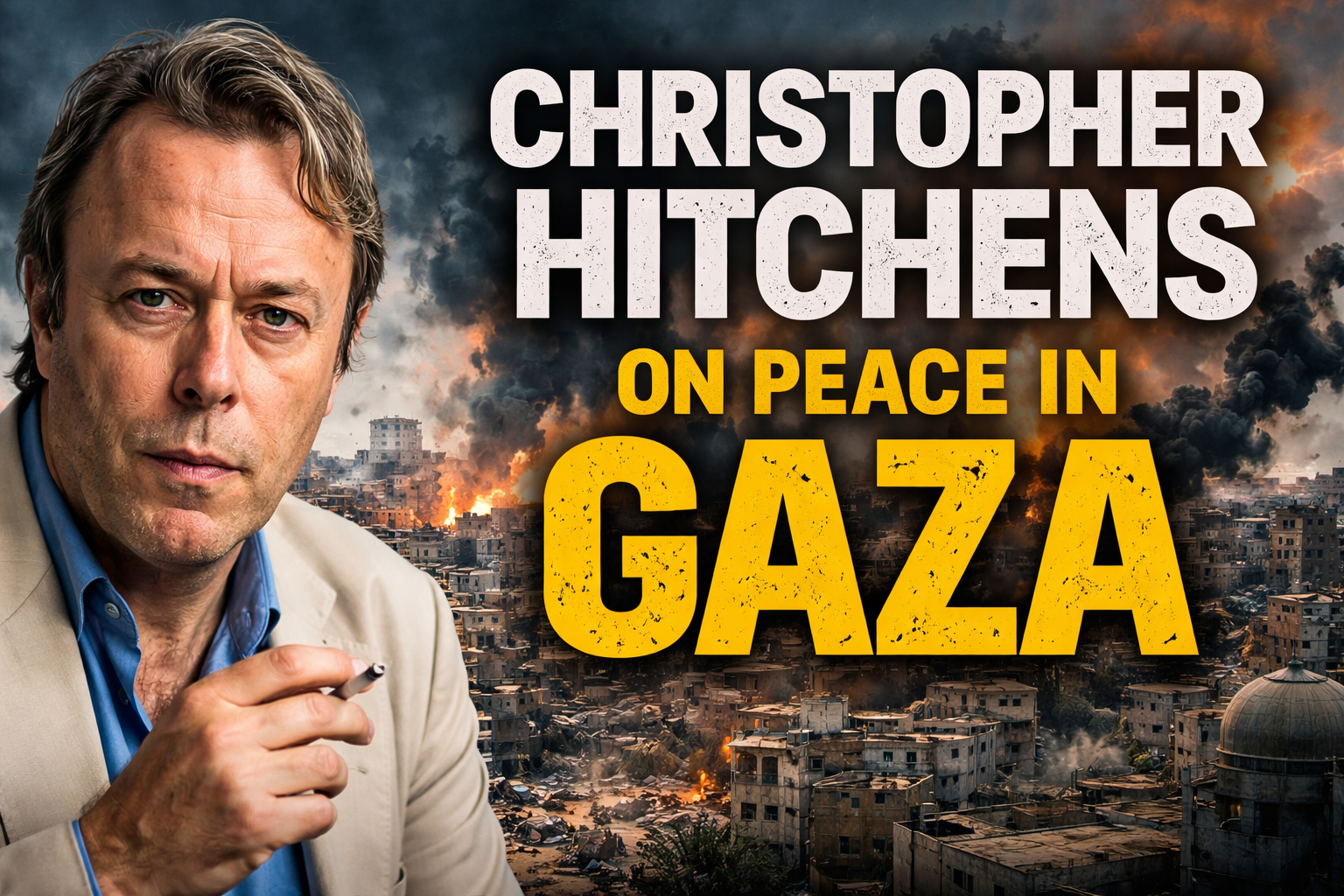
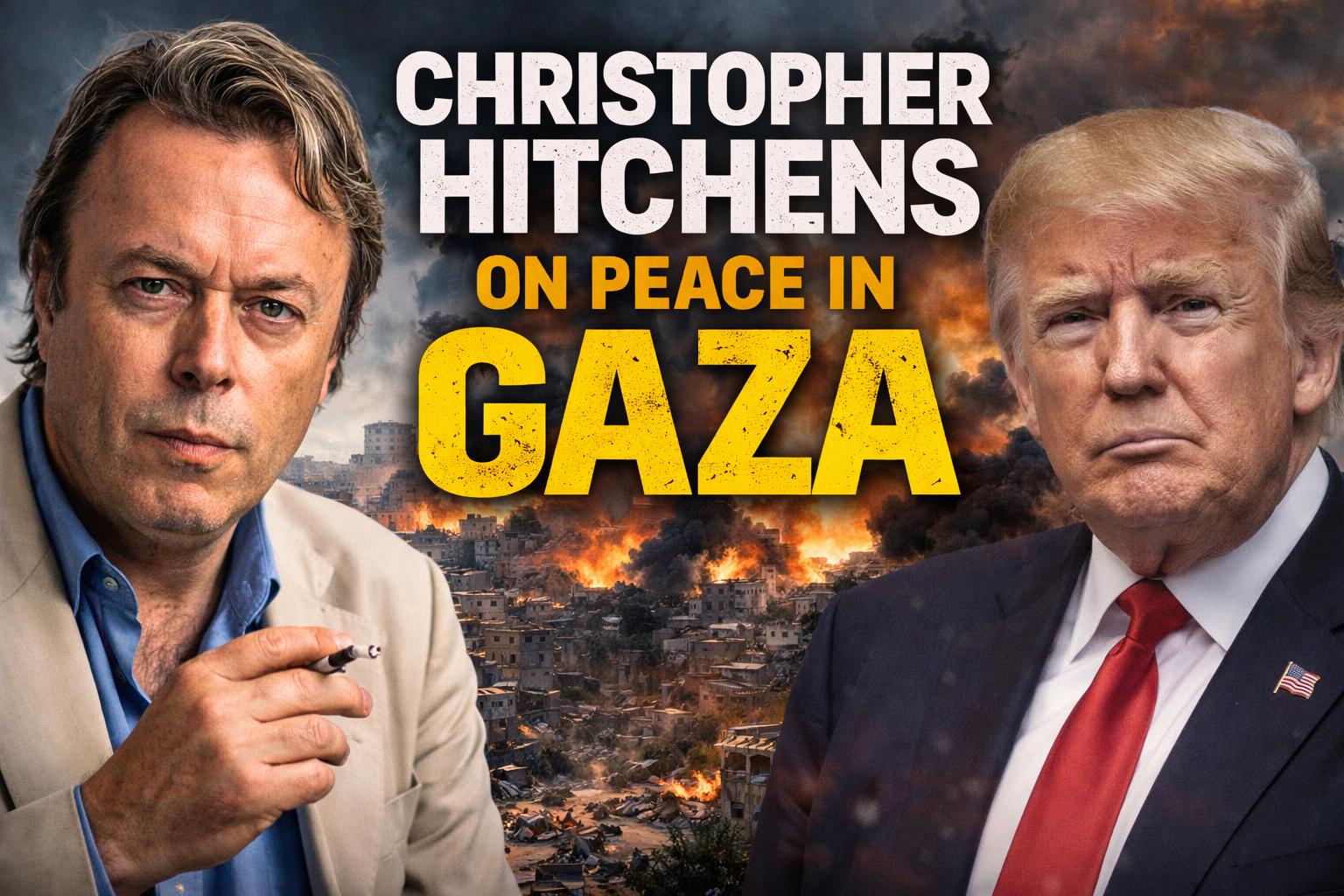
Few modern intellectuals spoke with the ferocity, moral urgency, and philosophical depth of Christopher Hitchens. A polemicist of uncommon courage, Hitchens devoted much of his career to confronting totalitarianism, religious fanaticism, and the moral evasions of both the left and the right. Although he passed away in 2011, his writings on Israel, Palestine, secularism, nationalism, and war provide a framework through which we can analyze today’s crisis and the elusive question of peace in the Gaza Strip.
This article examines Hitchens’ documented positions on Israel–Palestine, Hamas, nationalism, religion, and moral responsibility—and projects, carefully and faithfully, how he would likely analyze the contemporary calls for peace in Gaza. The goal is not to conscript him posthumously into a modern faction, but to understand his philosophical commitments and apply them consistently.
I. Hitchens and the Rejection of Tribal Thinking
Hitchens’ intellectual method began with a refusal: the refusal of tribal loyalty. He distrusted nationalism when it hardened into mythology. He rejected religious identity when it demanded obedience over reason. He disdained what he often called “sentimental” or “romantic” politics.
For Hitchens, the Israel–Palestine conflict was tragic not because it was ancient, but because it was perpetually manipulated by ideologues who benefited from its continuation. He criticized both Israeli expansionism and Palestinian authoritarianism. Crucially, he did not see the conflict as a clash of civilizations but as a conflict exacerbated by clericalism, corruption, and cynical power politics.
If we consider Gaza today through that lens, Hitchens would begin not with slogans—“Free Palestine” or “Stand with Israel”—but with moral clarity. Who governs Gaza? What ideology do they espouse? Who suffers? Who benefits from perpetual war?
II. Hamas and Theocracy: A Non-Negotiable Objection
One cannot interpret Hitchens’ likely view of Gaza without understanding his uncompromising opposition to theocratic politics. He was among the most forceful critics of political Islam, particularly movements that fused religion and state power.
Hamas, the governing authority in Gaza since 2007, defines itself explicitly as an Islamist organization. Its founding charter invoked religious language and eschatological struggle. For Hitchens, this would be decisive. He believed religious governance inevitably undermined pluralism, dissent, and individual freedom.
He would likely argue:
-
Peace cannot be durable where political authority is rooted in divine command.
-
Any state or territory governed by a movement that sanctifies violence faces structural barriers to reconciliation.
-
Secularization—not piety—is the prerequisite for coexistence.
Hitchens was no apologist for Israeli policy. But he consistently maintained that liberal democracy, however flawed, is morally preferable to theocratic authoritarianism. In his writings after 9/11, he insisted that Islamist movements must be confronted intellectually and politically, not excused as mere reactions to Western policy.
Applied to Gaza, Hitchens would likely condemn Hamas’ authoritarianism, its suppression of dissent, and its use of civilian infrastructure for military purposes. He would reject romanticized portrayals of militant groups as pure resistance movements.
However—and this is critical—he would not stop there.
III. Israeli Policy: Occupation, Expansion, and Moral Responsibility
Hitchens was sharply critical of Israeli settlement expansion in the West Bank. He argued that occupation corrodes democratic principles and fuels resentment. Though he supported Israel’s right to exist and defend itself, he did not offer blank moral checks.
He believed that nationalism, when fused with religious entitlement to land, becomes dangerous. Just as he opposed Islamist theocracy, he would be wary of religiously justified territorial expansion.
Regarding Gaza, he would likely scrutinize:
-
The humanitarian consequences of blockade.
-
The proportionality of military response.
-
The moral cost of civilian casualties.
-
The political short-termism of leadership on all sides.
Hitchens believed that moral responsibility increases with power. States, especially democracies, are held to higher standards precisely because they claim legitimacy through law.
Thus, while condemning Hamas’ ideology, he would simultaneously insist that Israeli leadership act with restraint and strategic foresight. Indiscriminate retaliation would, in his view, be both immoral and politically self-defeating.
IV. Peace as a Secular Project
Hitchens’ philosophy of peace was inseparable from his secularism. He argued repeatedly that durable peace requires the demystification of sacred claims. Land described as divinely promised becomes non-negotiable. Identity defined by scripture resists compromise.
For Gaza to move toward peace, Hitchens would likely argue for:
-
Secular Palestinian governance
A leadership not beholden to clerical authority. -
Democratic accountability
Institutions capable of internal criticism. -
Mutual recognition
Acceptance of Israel’s right to exist, and Israel’s recognition of Palestinian political agency. -
International realism
An end to the patronage systems that fund perpetual conflict.
He believed that modernity’s promise lies in replacing myth with law. Peace, therefore, is not sentimental harmony—it is institutional architecture built upon rights, reason, and accountability.
V. The Tragedy of Civilian Suffering
Hitchens had little patience for euphemism. He called atrocities by their name, regardless of the perpetrator. He would undoubtedly condemn attacks targeting civilians, whether in Israeli towns or Gazan neighborhoods.
But he would also object to the instrumentalization of suffering.
He often criticized movements that deliberately embed themselves among civilians to provoke retaliation for propaganda purposes. At the same time, he criticized states that treat civilian casualties as unavoidable collateral without moral reckoning.
Peace in Gaza, through Hitchens’ lens, would require ending the strategic exploitation of civilian vulnerability.
He would likely argue that genuine solidarity with Palestinians means opposing the forces that perpetuate their isolation—corrupt elites, militant absolutism, and foreign patrons who value symbolism over stability.
VI. The International Left and Moral Confusion
Hitchens famously broke with portions of the political left after 9/11. He accused parts of it of romanticizing anti-Western authoritarian movements under the guise of anti-imperialism.
Regarding Gaza, he would likely criticize simplistic narratives that cast one side as absolute victim and the other as absolute villain. He would reject binary moral frameworks.
His critique might include:
-
Condemning antisemitism disguised as anti-Zionism.
-
Rejecting Islamophobia masquerading as security analysis.
-
Opposing intellectual laziness in activist discourse.
For Hitchens, solidarity must not blind one to internal oppression. Supporting Palestinian rights cannot mean endorsing theocratic governance. Supporting Israeli security cannot mean excusing expansionism.
VII. The Question of a Two-State Solution
Historically, Hitchens supported a two-state framework as the most pragmatic path forward. Not because it was utopian, but because it acknowledged political reality.
However, he also warned that religious maximalism on both sides undermines territorial compromise.
Applied today, he would likely ask:
-
Is Hamas compatible with statehood grounded in pluralism?
-
Is settlement expansion compatible with a viable Palestinian state?
-
Are current leaders incentivized toward peace or toward perpetual mobilization?
Peace, in his vocabulary, would require political courage—the willingness to disappoint extremists on both sides.
VIII. Philosophical Foundations: Enlightenment vs. Absolutism
At heart, Hitchens’ worldview was Enlightenment liberalism: reason over revelation, individual rights over collective dogma, and skepticism over certainty.
The Gaza conflict, through that philosophical lens, represents a clash between:
-
Modern pluralism and religious absolutism.
-
Democratic accountability and factional militancy.
-
Secular law and sacred entitlement.
Hitchens believed that history bends not automatically toward justice, but toward whichever ideology organizes power most effectively. Therefore, peace in Gaza depends less on moral appeals and more on institutional transformation.
IX. Would Hitchens Be Optimistic?
Probably not in the short term.
He was too historically literate to indulge easy optimism. Yet he also believed in human agency. He admired dissidents—those who resisted authoritarian currents within their own societies.
He might place hope in:
-
Palestinian secular reformers.
-
Israeli peace advocates opposing expansion.
-
Cross-border civil society initiatives.
-
Generational shifts away from clerical dominance.
For Hitchens, hope was not a feeling but a commitment to argument.
X. Conclusion: Peace Without Illusions
To invoke Christopher Hitchens in discussions of Gaza is to invite discomfort. He would not flatter either camp. He would refuse slogans. He would dissect hypocrisy with surgical precision.
His likely position on peace in Gaza can be summarized:
-
Condemn theocracy unequivocally.
-
Defend democratic principles consistently.
-
Oppose expansionism and occupation.
-
Reject civilian targeting in all forms.
-
Demand secular governance as the foundation of coexistence.
Peace, in his philosophy, is not the absence of gunfire. It is the triumph of law over myth, citizenship over tribe, and reason over revelation.
If Gaza is ever to experience durable peace, it will not come through divine vindication or nationalist triumph. It will come through the slow, unglamorous work of secular institution-building, mutual recognition, and moral honesty.
And in that demanding, unsentimental vision, Christopher Hitchens would likely find both the tragedy—and the only plausible hope—of the region’s future.