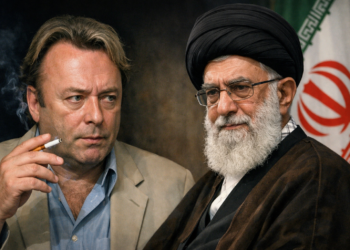


Christopher Hitchens, often dubbed the “Grand Inquisitor of Belief,” carved an indelible and often incendiary mark on the atheism debate, solidifying his reputation as a formidable public intellectual and an unapologetic contrarian. With a rhetorical arsenal honed by years of journalistic rigor and intellectual combat, Hitchens became a leading voice in the ‘New Atheism’ movement. His seminal work on the subject, ‘God Is Not Great: How Religion Poisons Everything,’ serves as a relentless indictment of faith, exposing what he perceived as its inherent flaws and devastating consequences. This exploration delves into Hitchens’ unflinching atheism, characterized by its polemical wit, unwavering logic, and a relentless pursuit of reason over revelation, challenging believers and agnostics alike to confront the uncomfortable truths he so articulately presented.

Deconstructing the Divine: Hitchens’ Core Anti-Theistic Tenets
The ‘Poison’ Thesis: How Religion Corrupts
At the heart of Hitchens’ critique lay his provocative “poison” thesis: the assertion that religion, far from being a benign or even beneficial influence, actively corrupts morality, reason, and human progress. He argued vehemently that the historical record is replete with instances where religious conviction fueled violence, intolerance, and obscurantism, rather than fostering genuine ethical behavior. For Hitchens, the moral compass derived from divine command was inherently flawed, demanding obedience rather than genuine compassion, and often leading to atrocities justified by sacred texts. He saw religion as an antiquated impediment, perpetually dragging humanity back from the precipice of enlightenment, suffocating critical thought under the dogma of unquestionable belief.
The Problem of Evil: The Logical Impossibility
Hitchens frequently wielded the classic Problem of Evil as a devastating logical cudgel against the concept of an omnipotent, omniscient, and omnibenevolent God. He argued with chilling precision that the existence of immense, gratuitous suffering in the world – from natural disasters to man-made cruelties – renders the idea of such a divine being utterly incoherent. If God is all-powerful, why does He not prevent evil? If He is all-good, why does He allow it? If He is all-knowing, why does He not intervene? To Hitchens, any attempt to reconcile these attributes with the harsh realities of existence devolved into intellectual contortions and special pleading, revealing a God either malevolent, impotent, or simply non-existent.
The Lack of Evidence: Dismissal of Faith and Revelation
Perhaps the most fundamental plank of Hitchens’ atheism was his unyielding demand for evidence. He dismissed faith, revelation, personal experience, and inherited tradition as valid proofs for the existence of God or the truth of religious claims. To believe something “on faith,” he argued, was to believe it without sufficient reason, a perilous intellectual shortcut that invited delusion and irrationality. He scorned the notion that extraordinary claims required anything less than extraordinary evidence, finding none whatsoever for virgin births, resurrections, divine interventions, or the countless miraculous tales upon which religions are founded. For Hitchens, an adult mind, if it is to be truly free and rational, must subject all propositions to rigorous scrutiny, especially those concerning the origins and meaning of existence.
Man-Made Mythology: Religion as a Human Construct
Hitchens saw religion not as a divine revelation but as a distinctly human construct, a projection of our fears, desires, and early attempts to comprehend a bewildering cosmos. He contended that ancient peoples, lacking scientific understanding, invented gods and myths to explain natural phenomena, give meaning to suffering, and provide solace in the face of death. These narratives, he argued, were designed to impose order on chaos, to control populations through fear and promise, and to answer questions that science would later elucidate with far greater precision and verifiable fact. For Hitchens, to cling to these antiquated mythologies in the age of reason was not merely charmingly quaint but actively detrimental to intellectual progress and individual autonomy.
Critiques of Religion’s Pillars: Morality, Science, and History
Religion and Morality: Challenging the Prerequisite
One of Hitchens’ most potent arguments targeted the pervasive notion that religion is a prerequisite for ethics. He passionately argued that morality is not divinely ordained but a product of human evolution, empathy, and social cooperation. Indeed, he frequently highlighted historical moral failures perpetrated in the name of God, pointing to inquisitions, crusades, jihads, and countless acts of discrimination and violence justified by religious texts. He challenged believers to find a single moral act that a secular humanist could not perform, or a single immoral act that a religious person had not committed. For Hitchens, true morality sprang from human reason and compassion, not from the arbitrary commands of an invisible overlord or the fear of eternal damnation.
Religion vs. Science: The Historical Conflict and Modern Incompatibility
Hitchens eloquently detailed the historical conflict between religious dogma and scientific inquiry, from Galileo’s persecution to modern battles over evolution. He rejected any attempt to reconcile science and religion as a desperate intellectual retreat by faith, often dismissing ‘intelligent design’ as a thinly veiled creationism dressed in pseudo-scientific garb. Science, he argued, thrives on doubt, evidence, and revisable hypotheses, constantly pushing the boundaries of knowledge. Religion, by contrast, relies on immutable dogma, unquestioning belief, and ancient texts, often acting as a brake on intellectual progress. He found the idea of a ‘God of the Gaps,’ where divinity is invoked to explain current scientific unknowns, particularly unconvincing and ultimately shrinking with every scientific discovery.
Historical Revisionism: Exposing Violence and Obscurantism
Hitchens was a meticulous historian, and he used his vast knowledge to expose what he considered religion’s egregious historical revisionism. He relentlessly chronicled the violence, intolerance, and obscurantism perpetrated throughout history in the name of God. From the Salem witch trials to the sectarian conflicts in Northern Ireland, from the Crusades to the horrors of the Spanish Inquisition, he presented a damning indictment of religious zealotry. He argued that instead of being a force for peace and enlightenment, religion has too often been the primary engine of conflict, suppressing free thought, stifling scientific advancement, and demanding conformity through terror. He saw this not as an aberration but as an inevitable outcome of a belief system rooted in unquestionable authority and absolute truth claims.

The Follies of Faith: Targeting Specific Dogmas and Figures
The Abrahamic Trilogy: Internal Contradictions
Hitchens held particular disdain for what he termed the “Abrahamic trilogy” – Christianity, Islam, and Judaism – dissecting their internal contradictions, historical inaccuracies, and moral failings with surgical precision. He highlighted the glaring discrepancies within their sacred texts, the arbitrary and often cruel laws attributed to their respective deities, and the sectarian violence these faiths have historically spawned. He famously critiqued the Old Testament God as a “cosmic bully,” the New Testament God as an irrational sacrifice, and Islamic teachings as intrinsically oppressive, especially towards women and non-believers. His critique was not a blanket dismissal but a detailed, informed assault on the specific dogmas he found most pernicious and illogical.
‘Worthy of Disbelief’: His Dismissal of Miraculous Claims
For Hitchens, the miraculous claims central to religious narratives – virgin births, resurrections, divine interventions, and prophecies – were simply “worthy of disbelief.” He considered them insulting to adult intelligence, demanding an abandonment of reason and a suspension of critical faculties. He would often quip that if God wanted to prove his existence, a clear, unambiguous, and universally verifiable miracle would suffice, rather than obscure events centuries ago, passed down through unreliable oral traditions. These stories, he argued, were the hallmarks of primitive credulity, designed to awe and control, and had no place in a rational world. He saw the very concept of a god interfering with natural law as a fundamental affront to scientific understanding.
The ‘Cosmic Tyrant’: How the Concept of God Mirrors Authoritarian Rule
One of Hitchens’ most profound philosophical critiques was his assertion that the concept of God often mirrors authoritarian rule, demanding unquestioning obedience and intellectual subservience. He famously stated that if there were a celestial dictator, the first moral duty would be to disobey. He saw religious worship as akin to psychological enslavement, requiring individuals to prostate themselves before an unseen, all-powerful entity, sacrificing their autonomy and critical judgment. This “cosmic tyrant,” he argued, demanded devotion not out of merit but out of sheer power, instilling fear of punishment and promising rewards for compliance, a system he found morally repugnant and intellectually demeaning to humanity.
Hitchens’ Rhetorical Arsenal: Wit, Eloquence, and Provocation
The Art of the Polemic: Mastery of Debate
Christopher Hitchens was a master of the polemic, transforming intellectual debate into a form of high art. His arguments were not mere opinions but meticulously constructed intellectual assaults, employing logic, history, and a staggering breadth of knowledge as his primary weapons. He understood the nuances of language and deployed it with surgical precision, dissecting opposing viewpoints with a combination of relentless questioning and devastating counter-arguments. He rarely engaged in ad hominem attacks but rather aimed at the integrity and consistency of the arguments themselves, leaving his opponents with little room for intellectual maneuver. His debates were spectacles of intellectual prowess, often leaving audiences exhilarated and challenged.
The Sting of Satire: Sarcasm and Irony
Perhaps his most recognizable rhetorical tool was the sting of satire, wielded with a surgeon’s deftness and a comedian’s timing. Hitchens employed sarcasm, irony, and brilliant turns of phrase to undermine religious arguments, often exposing their absurdities with a well-placed quip or a biting observation. He had an uncanny ability to turn his opponents’ words against them, revealing the inherent illogicality or hypocrisy of their positions. His wit was never gratuitous; it served as a powerful instrument to clarify his points, making complex philosophical arguments accessible and memorable, ensuring that his critiques resonated deeply, even with those who disagreed vehemently with his conclusions.
Unflinching Confrontation: Refusal to Compromise
Hitchens’ public persona was defined by his unflinching confrontation and an unwavering refusal to compromise or soften his stance, even in the face of personal adversity. Diagnosed with esophageal cancer, he continued to debate, write, and speak, embodying his commitment to reason until his final days. He saw intellectual integrity as paramount, believing that to back down from a principled argument, especially one as crucial as the nature of belief, was a betrayal of reason itself. This steadfastness, though sometimes perceived as arrogance, cemented his reputation as an intellectual titan who would not yield to sentimentality or popular opinion, insisting on absolute intellectual honesty.
Oratorical Power: Impact on Discourse
The impact of Hitchens’ public speaking and debates cannot be overstated. His distinctive voice, commanding presence, and rapid-fire delivery held audiences captive, shaping the discourse on atheism and secularism profoundly. He possessed a rare ability to articulate complex philosophical and historical arguments with clarity and passion, making them compelling even to those unfamiliar with the subject matter. Through countless public appearances, he elevated the debate, forcing both believers and non-believers to engage with uncomfortable questions and to re-examine their preconceived notions about faith, reason, and the human condition. His oratorical power ensured that his message reached far beyond academic circles, resonating deeply within the broader cultural conversation.
Legacy and Lasting Impact: The Hitchensian Challenge to Belief
The ‘New Atheism’ Movement and Hitchens’ Foundational Role
Christopher Hitchens was not just a participant but a foundational architect of the ‘New Atheism’ movement, standing shoulder to shoulder with figures like Richard Dawkins, Sam Harris, and Daniel Dennett. He provided much of the philosophical underpinning and rhetorical muscle for a movement that sought to challenge religious claims openly, critically, and without apology. His work, particularly ‘God Is Not Great,’ served as a manifesto, emboldening countless individuals to question dogma and embrace secularism. His influence helped shift the public conversation from polite accommodation of religion to a more direct and often confrontational critique, making it acceptable, even fashionable, to declare oneself an atheist.
His Contribution to Secular Humanism and Critical Thinking
Beyond atheism, Hitchens made an enduring contribution to secular humanism and the broader culture of critical thinking. He championed a worldview where ethics, meaning, and progress are derived from human reason, empathy, and endeavor, rather than divine decree. He consistently advocated for a society free from religious interference, where individuals are encouraged to think independently, question authority, and apply rational skepticism to all claims, especially those concerning the supernatural. His relentless pursuit of truth and intellectual rigor served as a powerful example for fostering a more rational and humane world, grounded in verifiable facts and human compassion.
The Ongoing Relevance of His Arguments
Even years after his passing, the ongoing relevance of Hitchens’ arguments in contemporary debates about religion, politics, and society remains profound. In an era marked by rising religious fundamentalism, sectarian conflict, and challenges to scientific consensus, his critiques of faith’s corrosive influence on reason and morality resonate more strongly than ever. His warnings about the dangers of unchecked religious authority, the perils of blind obedience, and the importance of free speech in confronting dogma continue to be vital tools for understanding and navigating complex global issues. His intellectual legacy provides a robust framework for engaging with these challenges in a thoughtful and principled manner.
His Enduring Call for Reason, Skepticism, and a Secular World
Christopher Hitchens’ enduring call for reason, skepticism, and the pursuit of a world free from religious dogma stands as his most significant legacy. He urged humanity to outgrow its mythological infancy and embrace the responsibilities and joys of a life lived without supernatural illusions. He believed that only by shedding the shackles of faith could humanity truly achieve its full potential, fostering a society based on justice, intellectual freedom, and human flourishing. His voice, sharp and incisive, continues to echo, challenging subsequent generations to think critically, question everything, and defend the precious space of secular enlightenment against the persistent encroachments of unreason.
Mọi chi tiết xin vui lòng liên hệ:
|