


If one wishes to understand the peculiar endurance of belief in God, one must first discard the comforting myth that religion persists because it is true, useful, or morally elevating. It persists because it is convenient. It offers certainty where none is available, authority where inquiry is difficult, and consolation at the cost of intellectual surrender. God, as traditionally conceived, is not an answer to life’s deepest questions. He is the interruption of them.
The central claim of theism is not merely that a god exists, but that this god demands submission—intellectual, moral, and political. This is not an abstract metaphysical proposition. It is a totalitarian one. The believer is instructed not simply to believe, but to obey. And obedience, history reminds us with depressing regularity, is the enemy of conscience.
Religion does not merely propose a creator; it proposes a ruler. A ruler who cannot be questioned, whose edicts are immune from revision, and whose supposed will is interpreted—quite conveniently—by fallible men with a keen interest in power. If this sounds familiar, it is because we have seen this structure before. It is the same architecture as any dictatorship, sanctified only by age and repetition.
Faith as the Abdication of Reason
Faith is often praised as a virtue. This is curious, because it is the only so-called virtue that actively discourages evidence. Faith is belief in spite of, not because of, reason. Were it otherwise, it would simply be called confidence or knowledge. To call faith a virtue is to applaud the suspension of critical thought.
One is told that faith provides answers science cannot. This is false. Faith provides assertions where science provides questions. Science admits uncertainty and corrects itself. Religion asserts certainty and punishes dissent. One system evolves; the other calcifies.
Consider the theological claim that morality requires God. This is among the weakest arguments ever advanced in the history of ideas. If morality is impossible without divine surveillance, then what we are describing is not ethics but fear. A person who refrains from murder only because he believes he is being watched is not moral; he is merely supervised.
Worse still, religion does not merely fail to produce morality—it often distorts it. Sacred texts contain endorsements of slavery, genocide, misogyny, and cruelty that would be considered criminal if proposed today. The believer’s response is telling: these passages are dismissed as “contextual,” while more convenient verses are declared eternal. In other words, the believer already knows right from wrong and consults scripture selectively to justify it. God, it turns out, is trailing behind human moral progress, not leading it.
God as an Explanation That Explains Nothing
Invoking God as the origin of the universe does not solve the mystery of existence; it merely postpones it. To say “God created everything” is to offer a label, not an explanation. One might just as easily say “magic did it” and be no worse off intellectually.
When pressed, theologians retreat into wordplay. God is said to be outside time, outside space, beyond comprehension—yet somehow deeply concerned with dietary laws, sexual habits, and which words are uttered during prayer. This is not profundity; it is evasion.
The religious mind often accuses atheism of arrogance. Yet what could be more arrogant than the belief that the universe was created with you in mind? That an infinite cosmos exists primarily to test your obedience? This is not humility; it is narcissism on a cosmic scale.
Atheism, properly understood, is not a claim to omniscience. It is the rejection of an unnecessary hypothesis. We do not say with certainty that no gods exist; we say that there is no evidence compelling enough to believe that one does. This is the same standard we apply to every other claim—except, curiously, religious ones, which are granted immunity from skepticism for purely cultural reasons.
Religion and the Cultivation of Guilt
One of religion’s most effective tools is guilt. The believer is taught that he is born flawed, that his natural impulses are suspect, and that redemption is conditional upon submission. This is not spiritual enlightenment; it is psychological conditioning.
The doctrine of original sin is particularly revealing. It asserts that humans inherit guilt for an act committed before they existed. In any other context, this would be called injustice. In religion, it is called doctrine. The message is clear: you are broken, and only the institution that diagnosed you can cure you.
This has profound social consequences. A population trained to distrust its own judgment is easily governed. A child taught that doubt is sinful will struggle to think freely as an adult. Religion does not merely shape belief; it shapes character—and not for the better.
The God Who Never Says Sorry
One of the more grotesque aspects of theistic belief is the moral asymmetry it creates. God is permitted any atrocity without accountability. Floods, plagues, earthquakes—these are framed as tests, punishments, or mysteries beyond human understanding. When a human ruler behaves this way, we call him a tyrant.
The believer is asked to worship a being who creates suffering and then congratulates himself for offering salvation from it. This is not love; it is extortion. “Worship me,” says the deity, “or suffer consequences that I myself have arranged.” If this proposal were made by a human authority, it would be recognized immediately as monstrous.
And yet, when questioned, the believer insists that God is the source of love. One wonders what definition of love requires eternal punishment for finite offenses. Hell, as a concept, is not justice. It is vengeance without limit, imposed by a being who claims moral perfection.
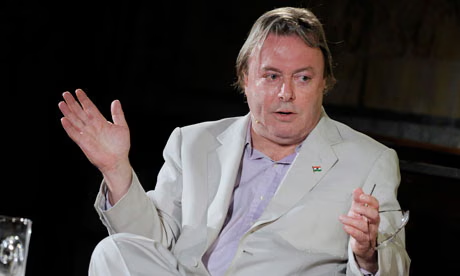
Why We Are Better Off Without God
The secular alternative is not despair, as religious apologists often claim. It is responsibility. Without divine supervision, morality becomes our task. Meaning becomes something we create, not something imposed. This is not a loss; it is an emancipation.
A world without God does not lack awe. The universe revealed by science is infinitely more astonishing than the parochial cosmos of scripture. A world without God does not lack ethics; it demands that we justify our values with reason and empathy rather than authority. A world without God does not lack purpose; it places that purpose squarely where it belongs—in human hands.
Religion asks us to kneel. Humanism asks us to stand.
Conclusion: The Courage to Think Without Permission
The question is not whether God exists. The question is why we have been taught that this question must dominate our moral and intellectual lives. Religion survives not because it is true, but because it discourages people from asking whether it is.
Christopher Hitchens understood that the real struggle was not between belief and disbelief, but between authority and inquiry. To reject God is not to embrace nihilism; it is to insist that ideas, like people, must earn our respect. No doctrine, however ancient, deserves exemption from scrutiny.
The most radical proposition is not atheism. It is the simple demand that we think for ourselves—without fear, without guilt, and without the need for celestial approval.
And that, perhaps, is the deepest heresy of all.