

 Introduction: Trump as Symptom, Not Accident
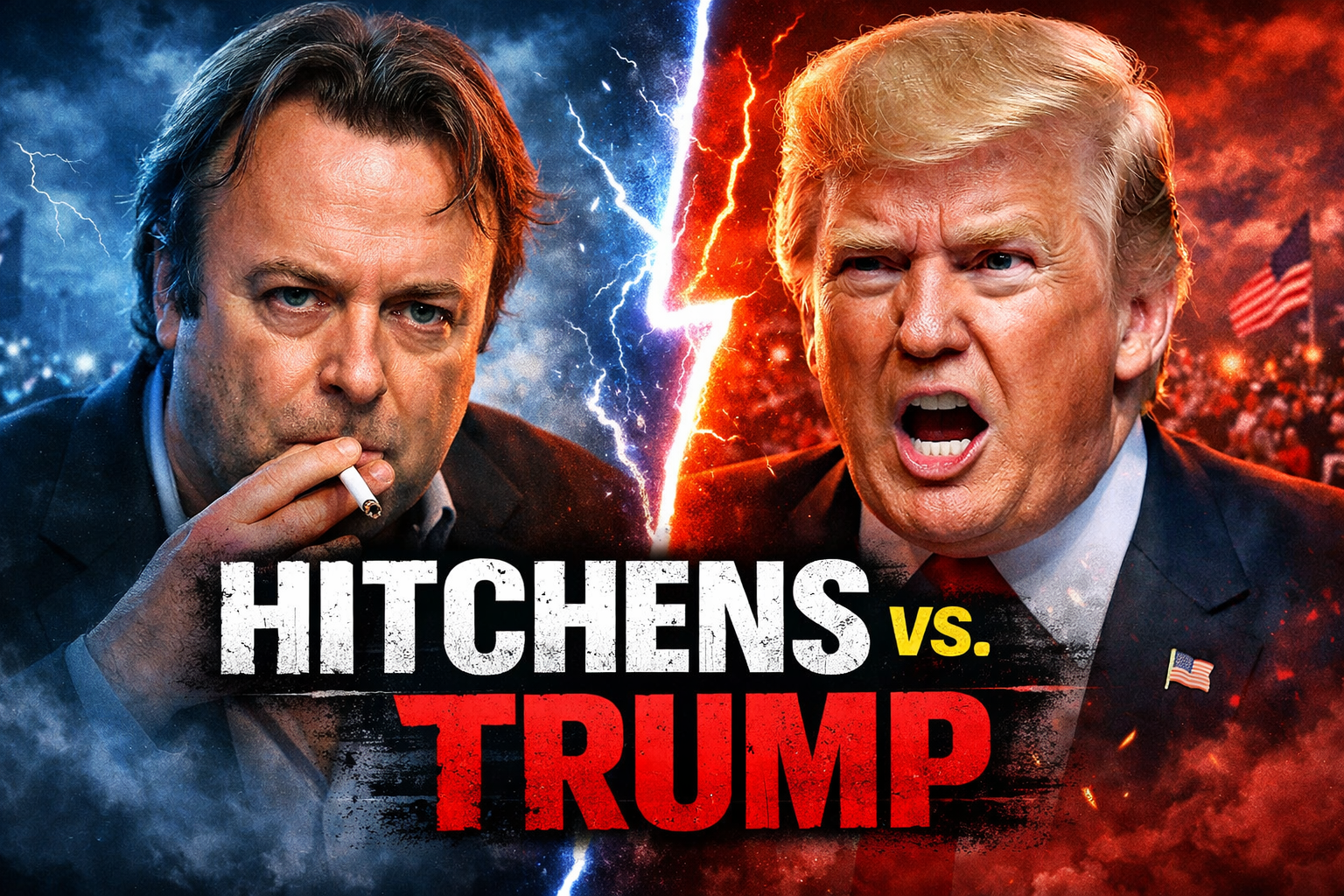
Had Christopher Hitchens lived long enough to witness the rise of Donald Trump, he would almost certainly have rejected the lazy explanation that Trump was a historical fluke. Hitchens despised comforting myths, especially those that absolved societies of responsibility. Trump, in a Hitchensian reading, would not be an aberration but a revelation—the exposure of a culture that had already made its peace with intellectual laziness, emotional manipulation, and the abandonment of evidence-based argument.

To analyze Hitchens’ likely view of Trump is not to speculate wildly. It is, rather, to apply a consistent worldview—one forged through decades of polemics against religious authoritarianism, nationalism, anti-intellectual populism, and the cult of personality. Trump, had Hitchens encountered him on the public stage, would have been treated not as a political innovator but as a second-rate strongman, a man whose appeal depended on grievance, spectacle, and the deliberate erosion of standards.
This essay explores how Hitchens’ core ideas—his hostility to demagoguery, his reverence for reason, and his ruthless contempt for intellectual fraud—map almost perfectly onto the Trump phenomenon. The result is a critique that feels not only plausible, but inevitable.
1. The Cult of Ignorance: Trump and the Celebration of Unknowing
Hitchens repeatedly warned that modern politics was drifting toward a celebration of ignorance. He did not mean simple lack of information—ignorance can be cured—but aggressive ignorance, the proud rejection of learning as elitist or unmanly. Trump’s political persona fits this diagnosis with uncanny precision.
Trump’s rhetorical style—boastful, repetitive, fact-indifferent—would have struck Hitchens as a deliberate performance of unknowing. Not merely “I don’t know,” but “I don’t need to know.” This posture, Hitchens would argue, is not accidental. It signals to supporters that expertise is suspect, nuance is weakness, and complexity is a trick played by enemies.
Hitchens once observed that authoritarian movements often begin by mocking intellectuals before silencing them. Trump did not silence; he ridiculed. Scientists, journalists, historians, and civil servants were lumped together as members of a conspiratorial “elite.” To Hitchens, this would not be populism in any noble sense—it would be anti-intellectual vandalism, a clearing of the ground so that slogans could replace arguments.
2. The Strongman Fantasy: Power Without Philosophy
One of Hitchens’ sharpest insights about authoritarianism was that true fascism requires ideology. It demands a coherent—if monstrous—vision of the state. Trump, by contrast, offered no such vision. Hitchens would almost certainly have rejected labeling Trump a fascist, not out of generosity, but out of contempt.
Trump’s politics, through a Hitchensian lens, would be described as solipsistic. The state exists to mirror the leader’s ego. Policy is improvisational. Loyalty replaces principle. Hitchens despised this form of power because it is empty yet dangerous—incapable of governing well, yet capable of enormous damage.
In Hitchens’ vocabulary, Trump would be a demagogue without doctrine: a man whose only consistent belief is self-adulation. This makes him less intellectually formidable than historical tyrants, but arguably more corrosive, because he reduces politics to entertainment and grievance.
3. Lies, Bullshit, and the Collapse of Truth
Hitchens drew a careful distinction between lying and bullshit. A liar knows the truth and hides it. A bullshitter is indifferent to whether statements are true or false. Trump, by this measure, would represent the triumph of bullshit in public life.
Trump’s falsehoods were not subtle. They were often easily disprovable, sometimes within seconds. To Hitchens, this would not indicate stupidity, but strategic contempt for truth itself. The point is not persuasion but dominance: forcing others to react, to fact-check, to protest—while the demagogue moves on, untouched.
This erosion of truth, Hitchens would argue, is fatal to democracy. A system based on debate cannot survive if facts are optional. Trump’s success would therefore signal not merely a political shift, but a cultural surrender.
4. Media, Spectacle, and the Addiction to Outrage
Hitchens was a fierce critic of modern media’s appetite for spectacle. Trump, a creature of television, exploited this weakness mercilessly. His every provocation generated attention; outrage became currency.
From a Hitchensian standpoint, Trump did not hijack the media—the media collaborated. Endless coverage of trivial scandals displaced substantive discussion. Politics became episodic, emotional, and theatrical.
Hitchens would not have spared journalists in his critique. He would have accused them of confusing access with importance, of mistaking noise for relevance. Trump thrived in this environment precisely because he understood that attention, not coherence, is power.
5. Nationalism Without Honor
Although Hitchens could be fiercely patriotic in his own idiosyncratic way, he despised chauvinistic nationalism. Trump’s “America First” rhetoric would have struck him as a parody of national pride—loud, shallow, and transactional.
For Hitchens, genuine patriotism involves self-criticism, an honest reckoning with history, and a commitment to universal values such as freedom of expression. Trump’s nationalism, by contrast, demanded loyalty without reflection and reverence without understanding.
This, Hitchens would argue, reduces a nation to a brand and citizenship to a chant.
6. The Religious Right and Moral Bankruptcy
Perhaps the most scathing Hitchensian critique would be reserved for Trump’s alliance with the American religious right. Hitchens spent much of his career exposing religious hypocrisy, and here the evidence would be overwhelming.
Evangelical leaders who preached sexual morality embraced a man whose life embodied every vice they publicly condemned. Hitchens would see this not as irony, but as proof that their faith was never about morality. It was about power.
Trump did not corrupt these movements; he revealed them. In Hitchens’ terms, they exchanged their god for a golden idol, and called it providence.
7. Why Trump Worked: The Failure of Liberal Confidence
Hitchens would not stop at condemnation. He would ask the harder question: why did this work? His answer would likely implicate liberals as much as conservatives.
Decades of technocratic language, moral timidity, and fear of offense created a vacuum. Into that vacuum stepped a man who spoke crudely but confidently. Hitchens believed that reason must be defended aggressively, not apologized for. Where liberals hedged, Trump asserted.
Trump’s rise, then, would be framed as a failure of intellectual courage across the political spectrum.
Conclusion: The Trump Era as a Warning
Christopher Hitchens would not have treated Donald Trump as an unspeakable anomaly. He would have treated him as a warning—a flare shot into the night sky, revealing the contours of a deeper decay.
Trump, through a Hitchensian lens, is not the end of American democracy, but a stress test it barely passed. He exposed how easily truth can be discarded, how readily ignorance can be mobilized, and how fragile reason becomes when citizens prefer affirmation to argument.
Hitchens believed, stubbornly, in the power of words, evidence, and ridicule directed upward. His response to Trump would not have been despair, but combat—intellectual, relentless, and unsparing.
The lesson he would leave behind is as sharp as ever:
Democracy does not die only when tanks roll in. It also dies when citizens stop caring whether what they are told is true.
In the age of Trump—and beyond—that warning remains uncomfortably relevant.