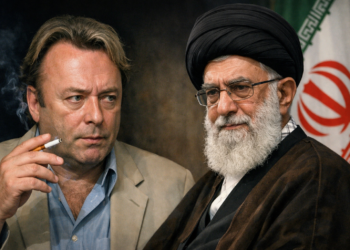


In an age increasingly prone to intellectual timidity and the soothing balm of consensus, Christopher Hitchens stood as a magnificent, uncompromising exception. A public intellectual, a polemicist par excellence, and an unapologetic provocateur, Hitchens carved out a formidable reputation not merely for his encyclopedic knowledge and piercing intellect, but for a caustic wit and an unflinching honesty that few dared to emulate. He was, quite simply, an indispensable iconoclast, armed with the precise language of a classical scholar and the pugilistic instincts of a street fighter, always ready to engage in the intellectual skirmish. This exploration delves into the consistent, confrontational stance Hitchens adopted against dogma in all its insidious forms – be it political cant, religious doctrine, or the comfortable delusions of faith – all delivered with his signature, sardonic style that left no intellectual sanctuary unchallenged.

The Political Arena: From Revolutionary Zeal to Pragmatic Realism
Christopher Hitchens’ political journey was anything but linear, a testament to his evolving intellect and unshakeable commitment to independent thought. He commenced his public life steeped in revolutionary zeal, embracing Trotskyism in his youth, a flirtation with the radical left that, for many, defines the early years of an idealist. Yet, unlike many who cling to youthful ideological constructs, Hitchens’ acute observational skills and his profound disdain for hypocrisy led him to a profound disillusionment with the very left he once championed. He saw, with unnerving clarity, the nascent totalitarian impulses festering within certain socialist movements, recognizing the seeds of authoritarianism in grand, utopian designs that promised heaven but delivered hell.
His critiques of totalitarianism and authoritarianism were legendary, not least for their targets. Hitchens famously tore down the carefully constructed mythologies surrounding figures like Mother Teresa, exposing what he perceived as her alliance with despotism and her perpetuation of suffering rather than its alleviation. He was equally unsparing in his dissection of Henry Kissinger, whom he accused, with compelling evidence, of war crimes and egregious abuses of power, meticulously documenting the diplomat’s culpability in countless atrocities. Hitchens possessed an uncanny ability to peel back the layers of public adoration and expose the often-squalid realities beneath. He was a political auditor, ensuring that those in power, and those who lionized them, were held accountable to an uncompromising moral and historical standard.
Perhaps no period better encapsulated his complex political identity than his stance on the Iraq War, an alignment with the Bush administration that alienated many of his former allies on the left and birthed the infamous ‘Hitch-22’ paradox. While he vehemently opposed the war’s architects on virtually every other policy, he supported the invasion as a necessary measure against a tyrannical regime, Saddam Hussein’s, which he had long condemned. This controversial decision, born of a deep-seated anti-totalitarianism rather than any newfound conservatism, highlighted his unwavering commitment to secularism, anti-fascism, and free speech. These principles were not mere talking points but the very bedrock of his political philosophy, transcending conventional left-right divides and compelling him to follow his convictions, regardless of the company he found himself keeping or the vitriol he attracted. He consistently argued that the moral imperative lay in confronting tyranny, irrespective of the inconvenient alliances it might demand, an intellectual courage many found admirable, others infuriating, but none could ignore.
The Religious Front: ‘God is Not Great’ and the Case Against Belief
Christopher Hitchens strode onto the religious front like an intellectual Goliath, wielding the formidable slingshot of reason against the entrenched dogma of millennia. He was, without hyperbole, a pioneering voice in what came to be known as the ‘New Atheism’ movement, a vocal champion of reason over revelation, and a relentless interrogator of the unexamined life. For Hitchens, the notion of a benign, omnipotent deity was not merely improbable; it was intellectually offensive, morally bankrupt, and ultimately, dangerous. He saw religion not as a private comfort, but as a public menace, a claim he articulated with devastating precision in his magnum opus, ‘God is Not Great: How Religion Poisons Everything’.
The core arguments from ‘God is Not Great’ reverberated through public discourse with the force of a theological earthquake. Hitchens systematically dismantled the comforting illusions of faith, arguing that religion, far from being a source of moral guidance, was responsible for inciting violence, perpetuating ignorance, suppressing scientific inquiry, and fostering a culture of blind obedience. He challenged the very premise that belief in a deity was a prerequisite for morality, asserting, with characteristic bluntness, that human beings could, and indeed did, construct ethical frameworks without recourse to supernatural commandments. For Hitchens, morality sprang from empathy, reason, and an understanding of our shared humanity, not from the arbitrary dictates of ancient texts or mythical figures.
His critiques were not vague generalities; they were specific, surgical strikes against the most revered doctrines, texts, and figures across Abrahamic faiths and beyond. He meticulously exposed the historical absurdities, logical inconsistencies, and moral failings embedded within the Bible, the Quran, and other holy scriptures, often pointing out how these texts were used to justify cruelty, misogyny, and oppression throughout history. He challenged the narrative of divine inspiration, positing that these were human constructs, riddled with human flaws and prejudices. Hitchens made a powerful, uncompromising moral and intellectual case against religion, asserting that it actively impedes progress, fosters ignorance by demanding belief without evidence, and justifies unspeakable cruelties in the name of a higher power. To him, religion was not just wrong; it was actively harmful, a poison seeping into the wellspring of human potential. His demand was for intellectual honesty and a rejection of manufactured comforts, no matter how ancient or widespread the delusion.

The Nature of Faith: A Delusion in Search of a Chain of Command
Christopher Hitchens, ever the precise definer, understood that to critique effectively, one must first differentiate. He drew a crucial distinction between religion, which he understood as institutionalized belief systems with their attendant rituals, dogmas, and power structures, and faith itself, which he characterized as the unthinking, unquestioning embrace of belief without evidence. While he condemned the institutions of religion for their historical abuses and intellectual stagnation, his disdain for faith was perhaps even more profound, seeing it as the fundamental intellectual surrender, the embrace of irrationality as a virtue, and a species of magical thinking that impedes genuine understanding.
For Hitchens, the embrace of irrationality, the willing suspension of critical faculties in favor of supernatural explanations, was an anathema. He saw faith as a cognitive shortcut, a comfortable delusion that absolved individuals of the arduous task of critical inquiry and empirical investigation. His challenge was to the very concept of “belief for belief’s sake,” arguing that such intellectual capitulation not only stifled personal growth but also had corrosive effects on public discourse and policy. He lambasted the notion that some propositions should be immune to questioning or skepticism simply because they fell under the umbrella of ‘faith,’ insisting that all claims, particularly those with profound societal implications, must withstand the rigorous scrutiny of reason and evidence.
He was particularly scathing in his critiques of ‘faith-based initiatives’ and the broader erosion of empirical evidence in public discourse. Hitchens correctly identified a creeping tendency to conflate spiritual conviction with practical efficacy, where good intentions, however divinely inspired, were deemed sufficient substitutes for data-driven results. He argued that allowing faith to dictate public policy or educational curricula was not merely inefficient but dangerous, leading to the privileging of superstition over science, dogma over demonstrable fact. In this vein, he became a tireless advocate for skepticism, empiricism, and human reason as the only legitimate paths to understanding the universe and navigating the complexities of human existence. To Hitchens, to choose faith over evidence was to choose intellectual servitude, to prefer the comforting lie over the liberating, if sometimes harsh, truth. His call was for an intellectual awakening, a rejection of mental shackles, and a courageous embrace of our capacity to comprehend the world through our own faculties, unburdened by ancient myths or divine decrees.
The Hitchensian Style: Rhetoric, Wit, and the Art of Polemic
To merely describe Christopher Hitchens’ arguments is to miss a significant, indeed indispensable, dimension of his impact: his unparalleled style. He was a master craftsman of language, a rhetorical gladiatorial whose every pronouncement was designed not merely to inform, but to devastate. His arsenal of rhetorical techniques was vast and varied, deployed with the precision of a surgeon and the force of a sledgehammer. Irony dripped from his pronouncements like acid, searing through flimsy arguments. Sarcasm was his rapier, parrying weak points with elegant, often brutal, dismissiveness. He peppered his discourse with classical allusions, effortlessly drawing upon history, literature, and philosophy to contextualize, elevate, and often mock contemporary follies, displaying a polymathic erudition that put most of his interlocutors to shame. But perhaps his most potent weapon was his devastating logic, an ability to trace an argument to its absurd conclusion with such clarity and intellectual rigor that it often left opponents speechless, or worse, self-contradicting.
His mastery of language was not merely ornamental; it was integral to his project of intellectual combat. He crafted eloquent and incisive arguments that cut through obfuscation like a laser. In a world increasingly saturated with euphemism, corporate speak, and the blandishments of political correctness, Hitchens’ prose was a breath of bracing, often acrid, fresh air. He believed in calling a spade a bloody shovel, and he did so with an unmatched lexical flair. He understood that the precise deployment of words could clarify, enlighten, and — crucially — dismantle prevailing orthodoxies with a potency that polite disagreement could never achieve. His arguments were not just reasoned; they were beautifully, sometimes savagely, composed, leaving an indelible mark on the intellectual landscape.
The cornerstone of his approach was his unwavering ‘no sacred cows’ philosophy. Hitchens possessed an innate aversion to veneration, particularly of ideas or individuals deemed beyond reproach by popular sentiment. Whether it was Mother Teresa, Bill Clinton, the Pope, or the very concept of God, if an idea or figure was widely revered, Hitchens saw it as his intellectual duty to subject it to the most rigorous and often brutal scrutiny. He understood that unquestioning reverence was the breeding ground for dogma, an intellectual laziness that he found intolerable. He valued argument and truth above comfort and consensus, believing that genuine intellectual progress could only occur when every assumption, every received wisdom, was placed on the dissecting table and examined without sentimentality or fear. His commitment to intellectual combat was not born of malice, but of a profound conviction that truth emerged from the fray, sharpened and refined by the clash of ideas. He was a grand inquisitor of dogma, not to enforce belief, but to ensure that no belief went unquestioned.
Conclusion: The Enduring Legacy of the Grand Inquisitor of Dogma
Christopher Hitchens, in his incandescent, all-too-brief passage through the intellectual landscape, waged a consistent and unyielding war against conventional wisdom and orthodoxy in all its guises. From the shifting sands of political ideology to the unshakeable bedrock of religious faith, he challenged, he provoked, and he compelled. His contribution to public discourse was not merely in the specific arguments he advanced, but in the relentless advocacy for critical thinking and skepticism itself. He taught a generation, and continues to teach through his writings, that the first duty of an intelligent mind is to question everything, to accept nothing on faith, and to always, always demand evidence.
The continuing relevance of his critiques in a world still grappling with extremism, irrationality, and the seductive allure of simplistic answers is undeniable. In an era where tribalism often trumps truth, and emotional conviction frequently outweighs empirical fact, Hitchens’ clarion call for reason, honesty, and intellectual courage resonates more powerfully than ever. He offered no easy solutions, no comforting platitudes; instead, he offered the bracing challenge of intellectual maturity, the demanding path of self-scrutiny and relentless inquiry.
His unique voice, a blend of erudition, wit, and fearless confrontation, serves as a timeless call to intellectual courage. Hitchens implored us not to merely observe the world, but to engage with it, to dissect its claims, to challenge its authorities, and to shoulder the profound duty to question everything. In doing so, he left behind not just a body of work, but a formidable intellectual tradition: the unflinching, uncompromising scrutiny of dogma, a legacy that continues to inspire those who dare to think, and to speak, for themselves.
Mọi chi tiết xin vui lòng liên hệ:
|